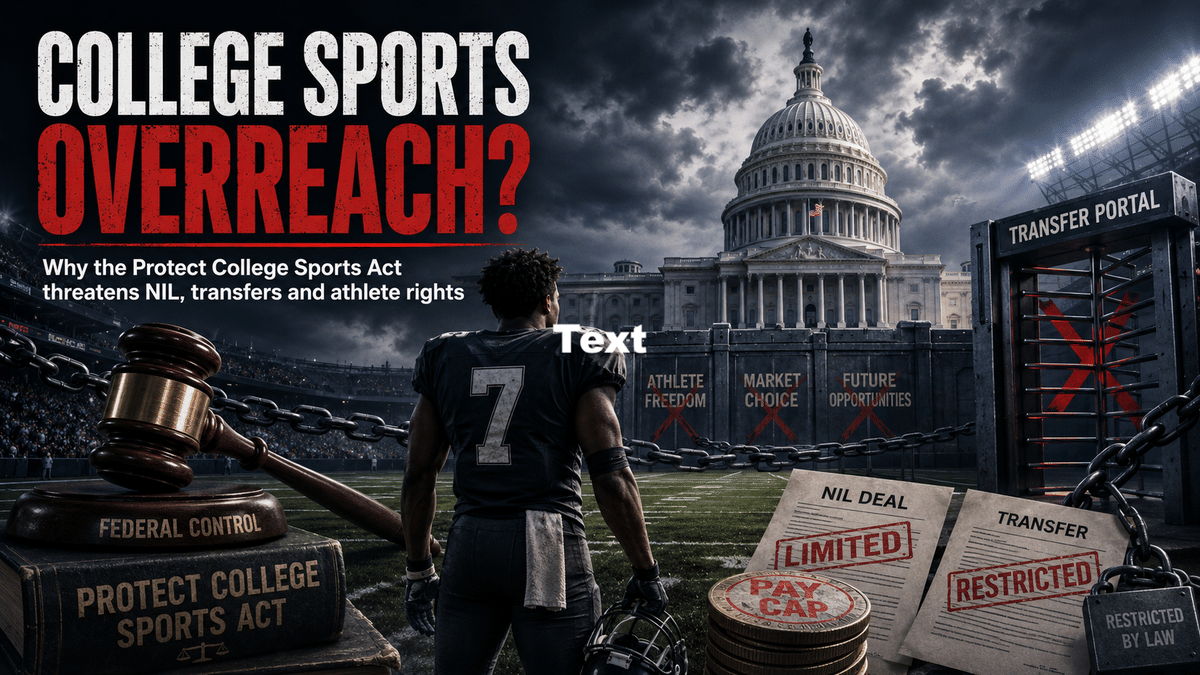
The Protect College Sports Act raises serious concerns about NIL and athlete rights, especially because it would cap compensation, limit transfer freedom and protect the NCAA from legal challenges.
That has been the through-line of college sports’ backlash against athlete empowerment from the beginning: not safety, not education, not competitive balance, but control.
Sen. Ted Cruz has long had a gift for aligning himself with powerful figures in college football circles, so it is of little surprise that this bill favors university presidents, conferences, coaches and the NCAA — the same groups that have fought for years against allowing the people who fuel the college sports money machine to receive a fair portion of the riches they generate, or meaningful power over the rules governing the sports they play.
The old power structure wants control back
Think Nick Saban and Dabo Swinney, two wildly successful coaches from the era directly preceding NIL and broad freedom of movement through the transfer portal. Both built championship programs when the power imbalance was obvious: coaches could leave, schools could make millions, conferences could cash television checks and athletes were expected to accept scholarships, wait their turn and be grateful.
College sports changed when athletes gained the ability to leverage their own value. Suddenly, the old recruiting pitch about “creating value” was not always enough to convince elite players to sit for two or three years behind someone else. Suddenly, players had options. They could transfer. They could earn. They could listen when another program offered more playing time, more money or a clearer path to the field.
That reality made life more complicated for coaches. It also made college football more honest.
The Protect College Sports Act seeks to reverse that shift. Its central bargain is dressed up as stability, but it is really about returning power to administrators, coaches, conferences and the NCAA. It would limit athletes’ freedom to move and earn while giving the institutions that control college sports broad protection from antitrust challenges.
The NIL protections come with a catch
The bill claims to preserve athlete NIL rights by barring schools, conferences and athletic associations from restricting an athlete’s ability to market NIL, earn NIL compensation or enter NIL agreements, subject — of course — to exceptions.
Those exceptions are the point.
Athletes would be required to report NIL agreements worth more than $600. The institutions they play for would send anonymized NIL data to the NCAA and College Sports Commission, which would maintain a public database supposedly designed to help athletes and agents estimate fair market value.
“Fair market value” is the kicker.
The bill was written to ensure athletes and their representatives remain at the mercy of schools, conferences and enforcement bodies in determining what that value is. It says NIL deals must have a valid business purpose and be commensurate with compensation paid to similarly situated non-athletes. That language is aimed at policing booster-driven or collective-funded payments that are framed as NIL but function more like recruiting inducements or roster payroll.
But the language is also vague enough to become a weapon. Who decides whether a business purpose is valid? Who decides whether compensation is commensurate? Who decides whether a quarterback, gymnast, point guard or softball pitcher is being paid for market value or being paid too much?
The answer, under this bill, is not the athlete. It is not a union. It is not a collectively bargained system. It is the same college sports power structure that spent generations insisting athletes were amateurs while everyone around them got rich.
A pay cap without collective bargaining
That is how we know what this bill really is. It does not recognize athletes as employees. It does not give them the right to unionize. It does not create a collective bargaining process. It does not require schools, conferences or the NCAA to bargain with athletes over compensation, health care, scheduling, roster limits, media-rights revenue or working conditions.
Instead, it studies those questions. It creates a commission to consider them later, after Congress has already handed schools the legal protection they have been asking for.
The bill would effectively federalize the House settlement’s revenue-share cap approved June 6, 2025, prohibiting schools, conferences, employees, volunteers and associated entities from arranging or providing compensation that would circumvent or cause a school to exceed that cap. Then it would extend that cap beyond the life of the settlement, adjusting it for inflation but preserving the basic structure.
That is not a free market. That is a federally protected compensation limit imposed on athletes who have no collectively bargained say in the system.
In professional sports leagues like the NFL, Major League Baseball and the NBA, salary caps and luxury taxes exist within labor systems that include collective bargaining agreements. Players have unions. They negotiate revenue splits. They bargain over free agency, benefits, discipline, travel, pensions, health care and workplace rules.
College athletes would get the cap without the union.
That distinction matters. A salary cap in a collectively bargained professional league is part of an agreement between labor and management. A compensation cap imposed on college athletes by Congress, while simultaneously declining to recognize them as employees, is something else entirely. It is management asking the federal government to lock in cost control before athletes gain the leverage to demand more.
Athlete protections around the edges
The bill includes provisions its supporters will tout as athlete protections. It would prohibit athletic department personnel from pressuring athletes into particular courses or majors, retaliating against academic choices or blocking internships, jobs and volunteer work — unless those activities conflict with class time or mandatory team activities.
That may sound fair until you remember that class time and team activities are always mandatory, and in college sports the team calendar often swallows everything around it. Coaches may not be allowed to pressure an athlete into a major on paper, but the athletic schedule still dictates what an athlete can realistically study, when they can intern and how much of the college experience they can actually access.
The bill also includes medical coverage requirements, scholarship protections and an athlete ombudsman. Those provisions are not meaningless. Some of them are overdue. But they do not change the power structure. They offer protections around the edges while preserving institutional control at the center.
That is the deeper problem with this legislation. It asks Congress to solve college sports by doing what college sports has always done: giving more authority to the people who already have it.
Federal control could backfire
The danger is not only to athletes. It is also to universities and conferences.
The bill would pull the federal government deeper into decisions about media rights, transfer rules, coach movement, recruiting windows, NIL valuation, postseason timing, broadcast access, conference structure and the preservation of rivalries. That is an extraordinary amount of federal involvement in what has historically been a messy but independent ecosystem of schools, conferences, courts, state laws, television partners and athletic associations.
College sports clearly needs national standards. The current system is chaotic. State NIL laws conflict. Transfer rules keep changing. Enforcement is inconsistent. The House settlement created a new compensation model without resolving the bigger labor question. The NCAA has spent years reacting instead of leading.
But a bad federal fix is still a bad fix.
Once Congress starts writing the operating manual for college sports, every major stakeholder will race to Washington for favorable treatment. Conferences will lobby for media-rights advantages. Schools will lobby for carve-outs. Coaches will lobby for roster and recruiting rules that protect their interests. Television networks will lobby around access and scheduling. The NCAA and CSC will lobby to preserve enforcement power. Athletes, who are younger, less organized and cycling through the system every few years, will be the least powerful constituency in the room.
That is how a bill sold as stabilization becomes regulatory capture.
Washington is not the answer
It is not hard to imagine how badly this could turn out. The federal government could freeze into law a system that is already outdated by the time it takes effect. It could create national standards that favor the richest conferences while claiming to protect everyone else. It could make it harder for athletes to challenge unfair rules in court. It could turn NIL enforcement into a bureaucratic guessing game. It could leave universities stuck complying with a federal sports regime that satisfies neither athletes nor administrators.
And it could give Congress a recurring role in college sports politics, which should worry everyone.
Imagine annual hearings over playoff access. Imagine senators pressuring conferences over rivalry games. Imagine lawmakers from football-rich states using federal law to protect local interests. Imagine every future dispute over transfers, revenue sharing or media distribution becoming another lobbying fight.
That is not stability. That is Washington discovering a new playground.
Media-rights pooling leaves athletes outside the room
The bill’s media-rights provisions are especially revealing. It would allow a broad entity of schools and conferences to pool and sell media rights with antitrust protection, provided certain conditions are met. Supporters will argue that this could prevent a Big Ten and SEC breakaway and preserve broader access across Division I. That may be the sales pitch. But the mechanism is still a federally blessed media cartel in which schools and conferences would coordinate the sale of rights while athletes would remain outside the bargaining structure.
The people on the field would still not have a true seat at the table.
That is the central flaw running through the bill. It treats athletes as the subject of regulation, not as parties to negotiation. It gives them representation in limited governance settings, but not bargaining power. It gives them an ombudsman, but not a union. It gives them disclosures, databases and compliance processes, but not control over the economic system built on their labor and fame.
Athletes need bargaining power, not more restrictions
College sports does need rules. It needs transparency. It needs enforceable health and safety standards. It needs real medical protections. It needs mechanisms to preserve Olympic and women’s sports. It needs a sustainable model that does not destroy every non-revenue program in the pursuit of football money.
But none of that requires Congress to cap athlete earning power while shielding schools from antitrust scrutiny. None of it requires pretending NIL is protected while building a federal apparatus to police whether athletes are earning too much. None of it requires giving administrators more legal certainty than the athletes whose work creates the value.
A better bill would start from a different premise: athletes are not problems to be managed. They are central stakeholders. They should have a legally protected right to organize, bargain and participate in shaping the future of college sports. Any national revenue-sharing system should be collectively bargained. Any compensation limits should come with athlete consent. Any health care, scholarship and transfer rules should be negotiated with the people affected by them.
That would be stability rooted in fairness.
The Protect College Sports Act offers something else. It offers stability for the powerful, cost control for the schools, legal protection for the NCAA and conferences and a smaller, more regulated version of freedom for athletes.
Congress should reject it.
College sports does not need a federal law that drags athletes back toward the old amateur model under a new name. It needs a system that finally admits the obvious: the money is real, the work is real and the athletes generating the value deserve more than another set of rules written by everyone but them.
JASON WATKINS is the founder and publisher of HOF Media and host of the HOF College Football Show on YouTube. Write to him at jw@hofmedia.us
The SEC transition has been harsher on Brent Venables and the Oklahoma Sooners than anticipated, with a tough 1-4 start sparking fan concerns over Venables’ leadership.
Despite glimpses of offensive progress in their latest 26-14 loss at Ole Miss, Oklahoma’s 4-4 record has fueled doubts about Venables’ ability to steer the program through the SEC’s relentless competition. While injuries to key offensive players have created challenges, Venables’ hesitance to address coaching issues and poor communication within the offensive staff have only deepened the Sooners' struggles.
The failure of the offensive staff to communicate effectively and Venables’ hesitance to manage his coaching staff proactively have compounded the difficulties presented by mounting injuries.
Hesitancy on Display: The 4th-Down Decision
Venables' hesitation was encapsulated on Saturday, just six days after finally relieving Littrell of his duties as offensive coordinator: the 4th-and-4 timeout against Ole Miss late in the third quarter. Trailing by two scores, Oklahoma needed a jolt to stay in the game.
The situation was critical, but hardly complex. Coaches make these calls instinctively, often without a second thought. Instead, Venables used a timeout — only to ultimately bring out the punt team, a decision that deflated the offense and left fans scratching their heads.
If the choice was to punt, Venables could’ve delayed the game for a mere five yards instead of burning a precious timeout. If he intended to go for it, why not get his new play caller’s best play for the situation and make the call confidently?
Even if the Sooners fail to pick up the four yards, it would have signaled a willingness to take a chance — or give one — to an offense that has been less-than-inspiring all season.
In that one instance, Venables’ hesitation was as costly as a missed play. With the momentum squarely in favor of Lane Kiffin’s Rebels, burning that timeout only to punt sent the wrong signal to a young group on offense that is in serious need of someone who believes in them. Instead, he proved he didn’t trust them to get a measly four yards and extend a drive to get back into the game.
OU’s Identity Crisis on Offense
What we’re witnessing with OU’s offense is not merely a slump — it’s an identity crisis. Oklahoma fans are accustomed to high-powered, fast-paced offenses that can score almost at will. Littrell’s offense was anything but explosive for seven weeks, and Joe Jon Finley had a lackluster, scoreless latter half of Week 8, too.
To say the Sooners struggled to establish consistency would be an overwhelming understatement.
OU has struggled with untimely penalties and turnovers and suffered through a complete lack of innovation and creativity. The plays feel uninspired, lack direction and are devoid of explosive results.
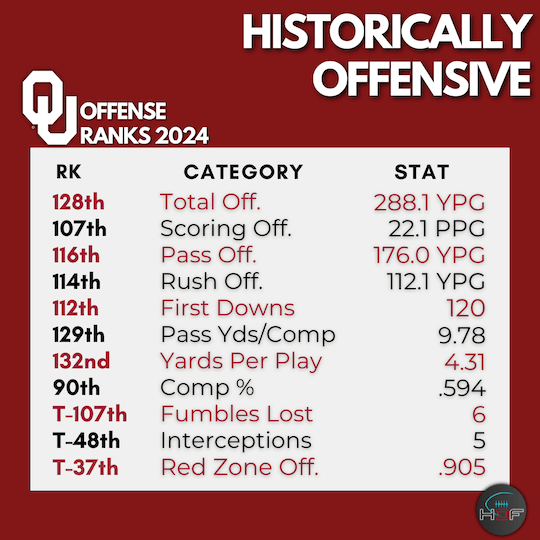
As a unit, this offense is drawing comparisons to the infamous John Blake era, and has the numbers to back the comparison up. ⬇️ ⬇️ ⬇️ ⬇️
There’s no other way to say it but bluntly … OU has no clear identity with its offense on the field.
The offensive woes go beyond play-calling; they’re structural. Reports from inside the Switzer Center suggest that there have been significant communication breakdowns within the offensive staff. Coaches have reportedly been on different pages regarding even the most fundamental elements, like blocking schemes. If those rumors are reaching the public, it’s safe to say Venables has known about these issues for some time.
A head coach — even a defensive-minded one like Venables — cannot allow such dysfunction to persist. These aren’t minor misunderstandings; they’re symptoms of a team struggling to find cohesion. Venables needed to address these issues early, before they became embedded in the team’s culture, but his delay in doing so has turned what might have been small fires into an inferno.
Mailed-In Hire: The Problem with Littrell
When Venables hired Seth Littrell, it felt like a placeholder decision. It wasn’t the bold, visionary hire that programs like Oklahoma should be making. Littrell’s track record showed some promise, but he had yet to prove himself as the kind of offensive mind that could elevate a program to championship contention.
Looking back on the decision to elevate Littrell and Finley, the hire seems more like an afterthought, a half-measure rather than a commitment to offensive excellence.
The results have been glaringly obvious. The offense lacks explosive creativity that OU fans are used to seeing, and that lack of energy has translated into downright unacceptable performances on the field, as evidenced by the Sooners’ historically bad statistical rankings in FBS football.
In just ten months on the job, Littrell and his offensive staff failed to the tune of numbers nobody in their right minds would have predicted following the Sooners’ 2023 season that saw the offense rank in the Top 5 in both Total Offense and Scoring Offense, and alone at the top of the Big 12 Conference in Points, Yards and Yards Per Play.
This despite having two of the most electric quarterbacks from their respective recruiting classes in the fold:
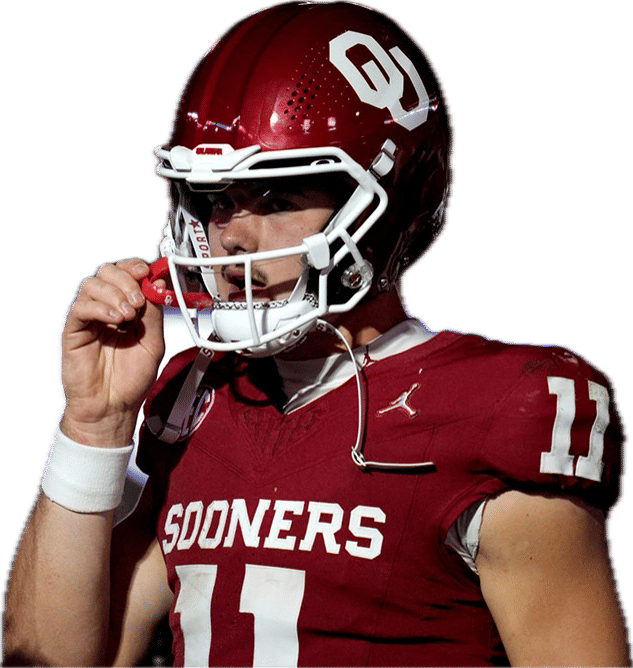
2023 5-star and Elite 11-winning Jackson Arnold of Denton Guyer, the 2023 Gatorade National HS Player of the Year and twice a Class 6A State Finalist in Texas.
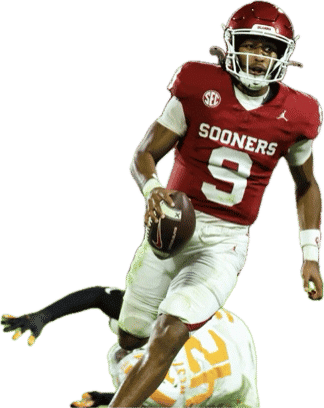
And former Allen and Frisco Emerson (Texas) superstar Michael Hawkins, Jr., a Sooner legacy trained by Kyler's father Kevin Murray, and who, as a senior, accounted for 55 touchdowns and just three turnovers, leading Emerson to within a game of playing for a Texas State Championship in Class 5A.
Neither were able to sustain success under Littrell's tutelage, and rumors have swirled this week about none of OU's QBs feeling as though been properly developed by the now-fired Littrell as the QBs coach.
Both started a games after being inserted for the other following ineffective play, and both came into their first appearances under Littrell with confidence and swagger that appeared missing by the time they were pulled from games after committing three turnovers and allowing the Sooners to fall behind teams they likely could have beaten were it not for the turnovers they committed.
In other words, Seth Littrell had to go.
Saturday’s loss leaves Oklahoma at 4-4, staring down a potential losing season -- the second for Venables since he arrived after the abrupt departure of Lincoln Riley to USC.
These are unacceptable at Oklahoma, a school with one of the richest football traditions in the country. What makes it even more alarming is that no longer can OU fans blame the losses on a ineffectice, suoddr defense — OU seems to have mostly turned the corner on that side of the ball — but to say the fan base is frustrated, would again be a massive understatement.
Oklahoma fans don’t want excuses; they want results. And for a head coach like Venables, the time for excuses is running out.
The Next OC Hire: BV’s Defining Moment
After Finally punting the Littrell experiment — once again needing more time than most believe he should have — Venables again finds himself in the market for a new offensive coordinator — for the third time in three seasons.
This time, though, the choice Venables makes will ultimately define his second tenure in Norman, possibly his entire future as a head coach in college football. Mailing it in would be tantamount to a dereliction of duty in the eyes of Sooner Nation.
Venables MUST get this one right. He has to bring in someone with a proven track record of offensive success, someone who can bring energy, innovation, and a clear identity to the offense. Anything less than a home-run hire will only deepen the cracks in Venables’ foundation as head coach.
If Venables fails to find the right offensive coordinator, his job security will slip through those cracks, and his tenure as the Head Ball Coach of the Sooners will die in a whimper. Even if he builds a defense that resembles the ’85 Bears, it won’t matter if OU’s offense can’t score points.
The OU fan base is patient to a degree, but they expect excellence. For Venables, this is a make-or-break moment.
Either he finds the right offensive coordinator and proves he can lead a balanced, championship-caliber team, or he risks being shown the door in a year or less.
The Venables Paradox: Championship Defense, JV Offense
The irony of Venables’ situation is that, in many ways, Oklahoma has become Lincoln Riley’s reverse image. Under Riley, the Sooners fielded prolific offenses but were plagued by a porous defense that could never quite get them over the championship hump.
With Venables, it’s the opposite: the defense has shown promise, but the offense is currently in full-on spiral.
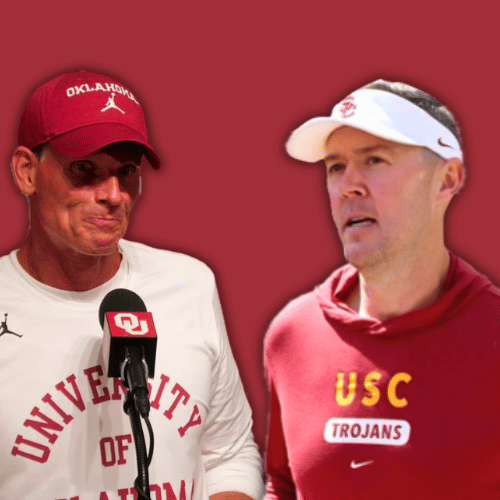
The head coach role, especially at Blue Blood OU, requires more than defensive expertise or recruiting prowess. It demands a complete vision, a well-rounded team, and an unwavering commitment to excellence on both sides of the ball.
For Venables to truly establish himself as a championship-level head coach, he has to be willing to delegate offense to someone who can make people forget he’s a defensive guru and simply call him “Coach.” To reach the heights that Oklahoma fans demand, Venables needs to be remembered not as a defensive mind but as a leader who fields a complete team. That requires taking risks, making tough decisions, and, most importantly, holding his staff to the highest possible standard.
It requires a decisive, confident vision for a championship future. The clock is ticking on Brent Venables’ tenure in Oklahoma, and his window for turning things around is narrowing.
Being the head coach at Oklahoma is an honor, but it’s also a responsibility. Venables needs to rise to that responsibility, or he and Lincoln Riley might both be in the job market this time next year.
________________
Jason Watkins is the Publisher at HOF Media Group and the Host of the HOF College Football Podcast. Reach him at jw@hofmedia.us